The Celestial Journal | Eternal Marigold
October 26, 2026 | Full Moon
By late October, the New England landscape has begun to change. The vibrant leaves that filled the trees only weeks earlier are falling. The evenings arrive sooner. There is a chill in the air that reminds us winter is approaching.
And above this changing landscape, another full moon is preparing to rise.
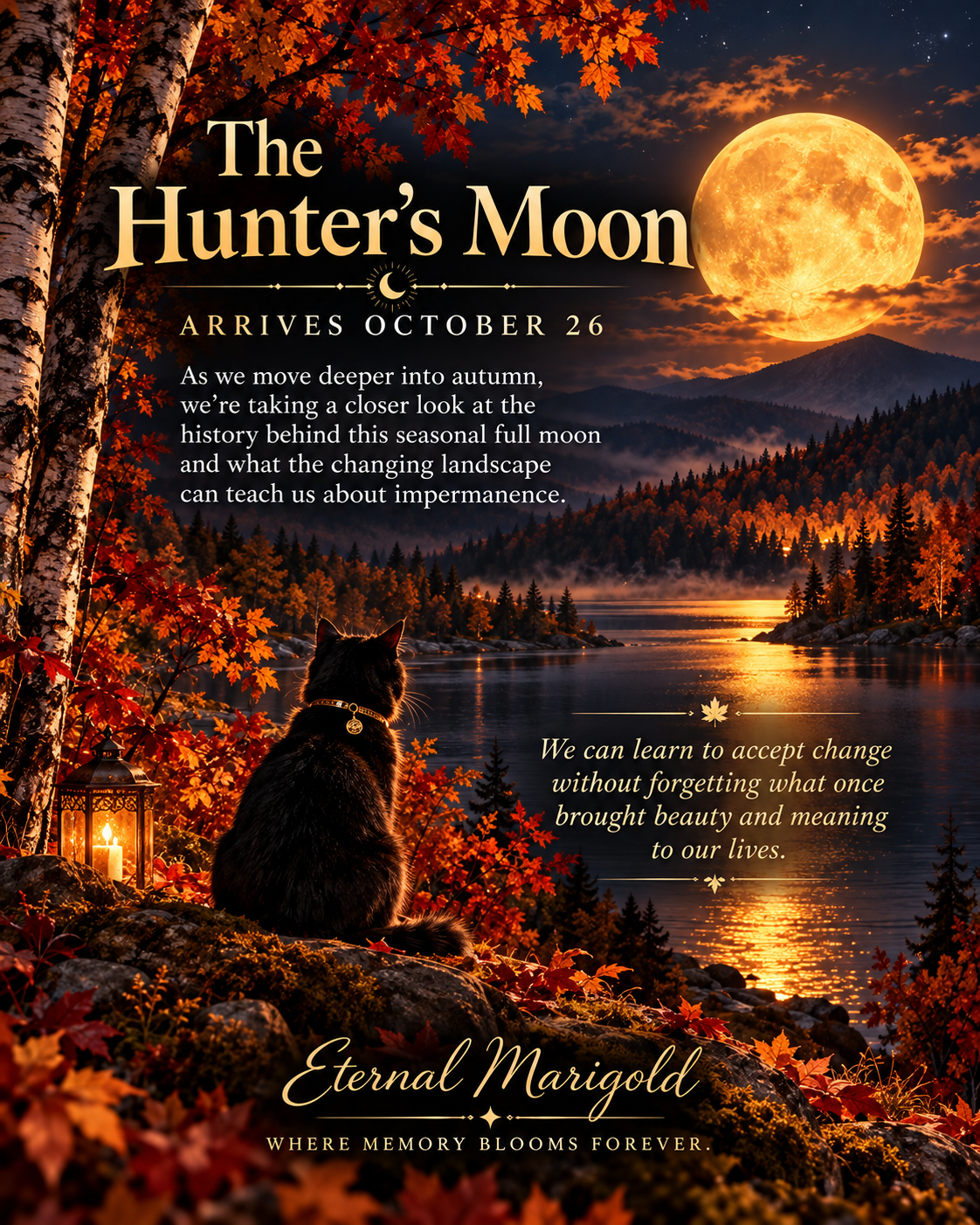
On October 26, 2026, we welcome the Hunter’s Moon, a full moon whose history is closely connected to the changing seasons, preparation, survival, and the natural cycles of life.
Beyond its place in the lunar calendar, the Hunter’s Moon offers an opportunity to reflect on something we all experience, whether we welcome it or not.
Change.
What Is the Hunter’s Moon?
The Hunter’s Moon is traditionally the first full moon following the Harvest Moon, which occurs closest to the autumn equinox.
In 2026, the Harvest Moon appeared on September 26. The Hunter’s Moon follows one lunar cycle later, reaching its fullest phase on Monday, October 26, at 12:11 a.m. Eastern Time.
The name has roots in older European seasonal traditions and reflects a period when communities prepared for the approaching winter.
After crops had been harvested, hunting became an important means of gathering food and storing provisions for the colder months. The brighter moonlit evenings provided additional light for activities that could continue after sunset.
Before modern lighting, the movements of the moon held practical importance in everyday life.
People depended on the seasons to know when to plant, when to harvest, when to prepare, and when to rest.
The Hunter’s Moon belonged to that rhythm.
A Moon With Many Names
Although Hunter’s Moon is the name most familiar to us today, different cultures have their own traditions for naming and observing the autumn moon.
Names such as Falling Leaves Moon, Drying Rice Moon, and Migrating Moon reflect different seasonal activities and observations of nature.
These names are not interchangeable traditions belonging to one culture. They come from different communities, landscapes, and relationships with the natural world.
What they share is an understanding that the earth changes throughout the year, and that human life has always depended upon recognizing those changes.
A falling leaf, migrating bird, or ripening crop once communicated something important about the season ahead.
In many ways, nature was humanity’s earliest calendar.
The Moon and the Buddhist Understanding of Impermanence
There is another perspective worth considering as we approach the Hunter’s Moon.
In Buddhist philosophy, one of the most important teachings is anicca, often translated as impermanence.
It is the understanding that conditioned things do not remain unchanged.
Our bodies change. Our relationships change. Our circumstances change. Even the emotions we experience today may be different tomorrow.
Nothing stays exactly as it was.
For those familiar with Theravāda Buddhist traditions practiced in Laos, Thailand, and other parts of Southeast Asia, the lunar calendar also carries religious significance.
The full moon and other lunar phases are associated with Uposatha observance days, when Buddhist practitioners may devote additional attention to mindfulness, meditation, ethical conduct, and the teachings of the Buddha.
The Hunter’s Moon itself is not a Buddhist observance. Its seasonal history and Buddhist teachings come from different traditions.
Yet the autumn landscape provides a beautiful illustration of impermanence.
The leaves do not remain green forever.
Flowers bloom, reach their fullest beauty, and eventually fade.
Even the full moon does not remain full.
And neither do we remain unchanged.
When Life Asks Us to Let Go
Autumn can be a difficult season for those experiencing grief, loneliness, or significant changes in their lives.
The shorter days and quiet evenings sometimes bring memories closer.
We may think about people who once shared our holidays, our homes, or our ordinary days. We may find ourselves remembering a particular autumn when life looked very different.
And sometimes, we miss the people we used to be.
The Buddhist teaching of impermanence does not ask us to pretend these losses are easy.
Nor does it mean we must stop loving someone simply because they are no longer physically present.
There is an important difference between accepting change and forgetting what mattered.
We can acknowledge that a chapter of our lives has ended while still honoring everything it meant to us.
We can carry memories without expecting life to return to what it once was.
And we can recognize that certain relationships, experiences, and seasons helped shape the people we are becoming.
Letting go of what cannot be changed does not require letting go of love.
Sometimes it simply means learning how to carry that love differently.
What Nature Knows About Change
When we observe nature, we begin to understand that change is not always a sign that something has gone wrong.
The trees lose their leaves because the seasons are changing. They conserve their resources to endure the colder months.
The flowers that bloomed throughout the summer have completed their growing season.
Some plants leave seeds behind. Others rest beneath the soil until conditions are right for new growth.
Nothing in nature remains in a constant state of blooming.
Yet we often expect that of ourselves.
We expect ourselves to remain productive, cheerful, strong, and emotionally available, even during periods of great difficulty.
We sometimes measure our lives by what we have accomplished instead of recognizing what we have endured.
Perhaps autumn offers a different perspective.
There are times to grow, times to gather, times to rest, and times to begin again.
Each has its place.
A Moment Beneath the Hunter’s Moon
As October 26 approaches, consider taking a little time to observe the changing season.
There is no special ritual required.
You might step outside and look toward the moon, take a quiet walk, sit beside a window, or spend a few minutes reflecting on the months that have passed.
Ask yourself:
What has changed in my life since the beginning of this year?
What am I still holding onto because I am afraid of what comes next?
What have I learned about myself through the difficulties I have faced?
What deserves my gratitude, even if it did not last?
What would it mean to move forward without abandoning the memories I treasure?
You do not need to have every answer.
Sometimes becoming aware of what we are carrying is enough for the moment.
The Wisdom of the Changing Seasons
The Hunter’s Moon once reminded communities that winter was approaching and preparations needed to be made.
Today, many of us no longer depend upon moonlight to gather food or prepare for survival.
But we can still learn something from the seasonal rhythms that guided earlier generations.
Life does not remain in one season.
There will be periods of abundance and periods of uncertainty. There will be beginnings we celebrate and endings we never anticipated.
Some changes will arrive by choice. Others will arrive without our permission.
What matters is how we learn to live within those changes.
As the Hunter’s Moon rises over the autumn landscape, perhaps we can remember that impermanence is not only about endings.
It is also what allows new beginnings to exist.
And while we cannot hold a season in place, we can appreciate its beauty while it is here.
The leaves will fall. The moon will wane. The seasons will change.
And through it all, we continue to live, to love, to remember, and to grow.