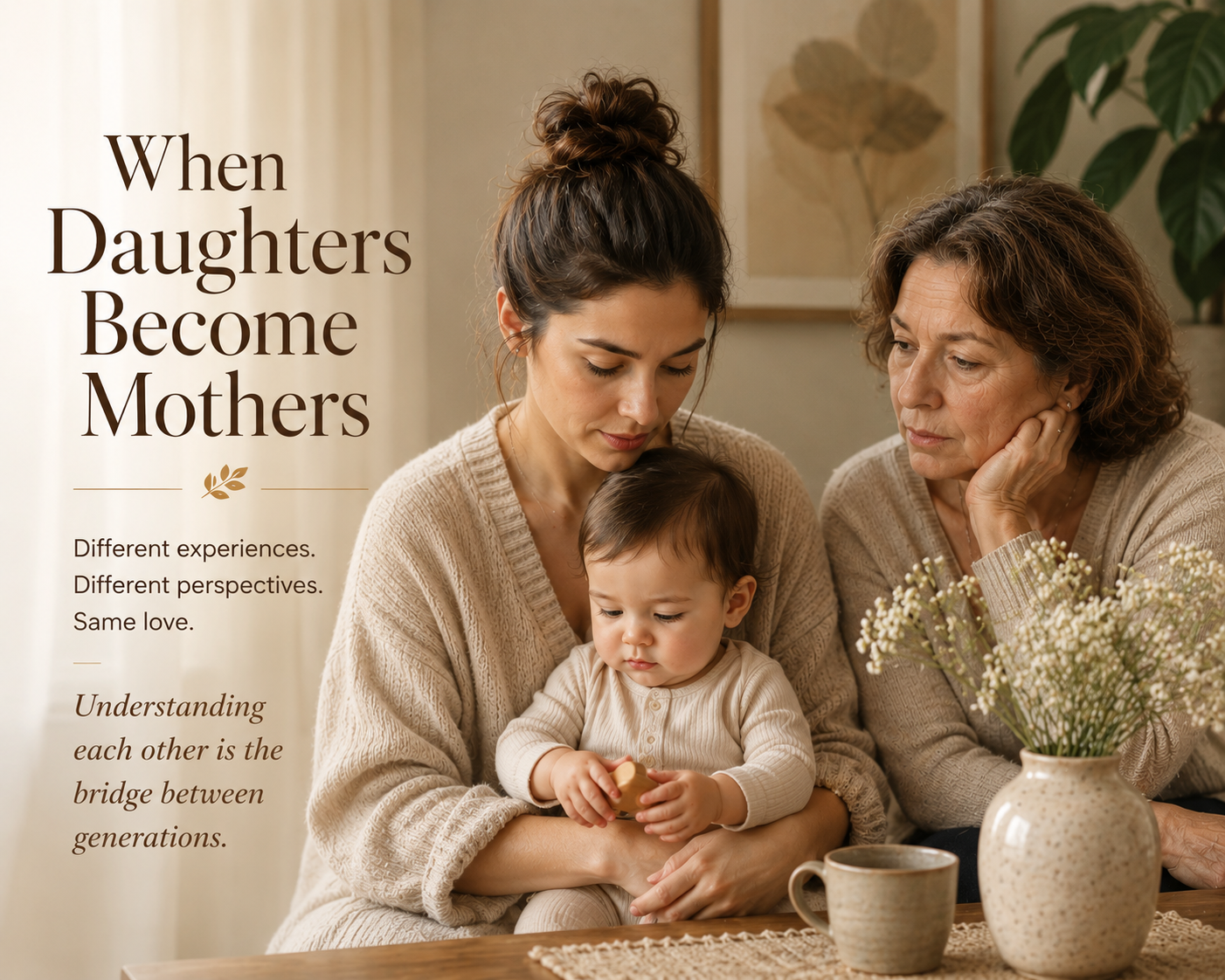
One of the most emotionally complex transitions in a mother-daughter relationship often begins the moment the daughter becomes a mother herself.
Because suddenly, the relationship is no longer only between mother and daughter.
Now it becomes mother and mother.
And within that shift, old emotional patterns, unspoken expectations, survival instincts, and generational differences often rise quietly to the surface.
The grandmother may feel she is offering wisdom, experience, love, and protection.
After all, she has already raised children of her own. Much of her life may have been shaped around sacrifice, caregiving, endurance, and keeping her family safe.
But the daughter is no longer only someone being guided.
She is now trying to become her own kind of mother.
And sometimes, that transition creates emotional friction neither woman fully understands at first.
Conversations about food, discipline, routines, emotional expression, independence, sleep, safety, or how a child “should” be raised can slowly become emotionally charged.
Not because either side does not love the child.
But because underneath those disagreements are deeper emotional questions many families never say aloud:
“Can you trust me to do this my way?”
“Can you allow me to parent differently than you did?”
“Can you understand that my choices are not always a rejection of yours?”
“Can you still see me as a good mother, even if I do things differently?”
At the same time, many grandmothers quietly carry emotions of their own.
Some women spent decades being needed by everyone around them.
Some survived difficult marriages, financial hardship, emotional suppression, immigration, sacrifice, or unstable family dynamics while raising children.
Some learned to express love through correction, worry, overprotection, or constant vigilance because softness did not feel safe in the lives they lived.
So when a daughter begins parenting differently - with new emotional language, different boundaries, gentler approaches, different nutritional beliefs, or more emotional openness - it can unintentionally stir grief, fear, confusion, or even feelings of displacement within the grandmother herself.
Meanwhile, daughters often experience something equally emotional after becoming mothers:
they begin seeing their own childhood differently.
Some suddenly understand their mothers more deeply than they ever did before.
Others begin recognizing emotional patterns they do not want to repeat with their own children.
Many experience both at the same time.
And this is what makes these relationships so emotionally layered across generations.
Not because love is absent.
But because motherhood often awakens emotional inheritance inside the family itself.
A daughter trying to create emotional safety for her child may also be trying to heal parts of herself.
A grandmother trying to protect her grandchild may also be protecting the survival instincts that once carried her through life.
Both are often loving from the experiences that shaped them.
And perhaps this is one of the quiet truths many women eventually realize:
becoming a mother can completely change the way a daughter understands her own mother.
Not always with blame.
Sometimes with grief.
Sometimes with compassion.
Sometimes with both.
And healing may begin the moment both women stop seeing each other as opponents across generations -
and begin recognizing that they were both shaped by very different emotional worlds.